4 sections in this chapter
The survey, and what it cannot do
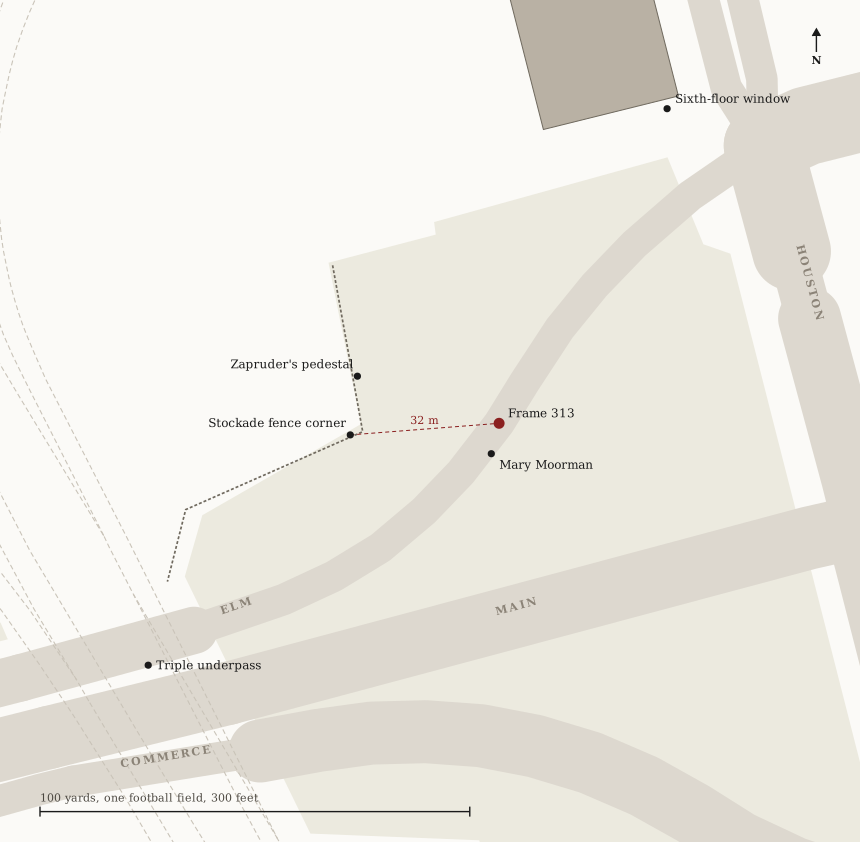
Everything measurable in this book comes from one table. In 1964 surveyors went into Dealey Plaza with instruments, ran a re-enactment, and recorded where the President’s car had been at fourteen specific frames of the Zapruder film. That tabulation is Commission Exhibit eight eighty-four, printed in volume seventeen of the hearings. Fourteen rows. That is the entire measured basis for the position of that car at any moment, and every reconstruction ever built, including this one, is filling the gaps between them.1#
Each row carries six numbers. The station, meaning how far along Elm Street in feet. The elevation above the survey datum. The straight line distance from the President to the rifle in the window. The depression angle from that window down to him. The distance to the top handrail of the triple underpass. And the angle to that. Six columns, fourteen times. Out of that grid comes every claim in this book about how far, how high and at what angle.1#
†Two of the fourteen rows are a problem and I would rather say so than quietly drop them. The exhibit puts frames one sixty-one and one sixty-six only nine tenths of a foot apart, which would mean the limousine was almost stationary for a quarter of a second. It was not. The distance column agrees with itself, so the tabulation is at least internally consistent, and the reconstruction reproduces both rows exactly as printed rather than correcting them. Hold on to that pair. Late in this book I go back and find out what is actually wrong with them, and it is not what I assumed.2#
The ground is not flat and no diagram drawn flat will give you a right answer. Elm, Main and Commerce all fall about twenty-four feet from Houston Street to the point where they pass under the railroad, and the streets cut a deepening notch as they go, because the lawns either side fall far more gently than the roads do. The model samples one elevation function for everything, so the streets, the lawns, the knoll and the buildings all agree with each other about where the ground is.3, 4#
§Ask where the car was at frame two hundred and twenty-four and the honest answer is that nobody surveyed it. Two twenty-two and two twenty-five were surveyed, so the model puts two twenty-four between them, proportionally, along the route. That is interpolation. It is defensible, every reconstruction does it, and it is not a measurement. Anywhere this book gives a position at a frame that is not one of the fourteen, it is arithmetic between two points that were, and it is marked as reconstruction.5, 6#
The camera ran at eighteen point three frames a second, established by testing the actual camera. That figure converts frames into seconds and seconds into distance, so it sits underneath every timing claim in the case and in this book. Change it slightly and the interval between shots changes, and with it the argument about whether one rifle could manage them. One decimal place, taken from a home movie camera, holds up the entire chronology.7#
§The live oak that blocked the view from the window is still on Elm Street and it has been growing ever since. The tree standing there today is not the tree that was there that afternoon, so modeling the present one would give you a sightline nobody ever had. The model uses a smaller canopy, with a gap in the leaves, because the record says the view opened through them. That is the single most interpretive object in the whole reconstruction and it is marked as one.8, 9#
Here is what a model like this is good for. Distance. Elevation. Angle. Whether a given position could see a given point at a given moment, and how far away it was. Those are geometry questions and geometry answers them the same way every time, regardless of who is asking or what they were hoping for. Almost every argument in this case that has run for sixty years contains at least one claim of that kind, buried inside it.10#
And here is what it cannot do, which matters more. It cannot tell you where a shot came from. It cannot tell you what anybody intended, or whether a person standing at a window was holding a rifle, or whether somebody was behind that fence. It has no opinion about any of that and it never will. A model is very good at geometry and completely silent on intent, and anybody who tells you their reconstruction solved this is selling something.10#
So why do it. Because the ground is the only part of this story that cannot be argued into a different shape. Every witness account is somebody’s word and every document is somebody’s account of somebody’s word. The distance from that window to that road was the same in 1963 as it is now, it does not care what anybody believes, and it can be checked by anyone willing to go and stand there. That is the whole reason this book exists in the form it does.10#
How you check me
Everything so far is how the thing was made, and making it is not the hard part. Anybody with the survey table and enough evenings can put a plaza on a screen. The hard part is the next question, which is whether the thing on the screen is the same shape as the place. So here is what it was checked against, where it disagrees with the official account, and what you would have to do to break it.11#
The strongest check available costs nothing. Put a camera in the model exactly where a real photographer stood, point it where they pointed, and compare. If the model is right, the buildings line up with the buildings in their picture, the curb falls where their curb falls, the sign sits where their sign sits. If it is wrong, it is obvious immediately, because a building in the wrong place cannot hide. That test has been run from the Moorman position, the Zapruder pedestal, the knoll and the sixth-floor window.12, 13#
The second check is time. The survey gives positions at fourteen frames. The film runs at a known speed. So the model has to move the car between those points at a pace the film actually supports, and if you have fudged the geometry the arithmetic stops working: the car arrives somewhere too early or too late and the whole thing falls out of step. Position and timing come from two separate sources, and they have to agree without being made to.5, 14#
§Now the part I would want to know if I were you. There is a place where the model and the official record do not fit. Two rows of the survey put the car almost stationary for a quarter of a second, which cannot have happened. I have told you about that already. What I did not say is what it costs: through those two frames the reconstruction cannot be trusted, and any timing argument crossing them is running over ground I do not believe in. I kept the bad rows and marked the gap rather than smoothing it. Later in this book I go back and find out what is actually wrong with them.15, 16#
Here is what this thing cannot do, and the list is longer than the other one. It cannot model a bullet. It has no ballistics in it, no air, no drag, no deflection off bone. It cannot tell you what a person saw, only what was geometrically visible from where they stood, which is not the same thing at all. It cannot see through the crowd. And it cannot put anybody in a window, because a model has no idea who is in a room.17#
So here is how to take it apart, seriously, and I mean this. Go to the plaza with a tape measure and check any distance in this book. Pull Commission Exhibit eight eighty-four and see whether I have used the numbers on it or numbers I preferred. Take any photograph from that day and see whether what I say was visible from that spot is visible in their picture. If one of those fails, the physical half of this book fails with it, and I would want to hear about it before anybody else does.18#
The row that is mislabeled
Twice in this book I have told you about the worst thing in my own reconstruction. Two rows of the 1964 survey put the President’s car nine tenths of a foot apart across five frames of film, which works out to about two miles an hour. The car was doing eleven. I said I had kept the bad rows rather than smoothing them, and that anything crossing that quarter second could not be trusted. What I want to do now is test it properly.19#
Here is the thing about that exhibit I had never made use of. Each row carries four numbers about where the car was: how far along Elm Street, how high above the datum, how far it was from the rifle in the window, and the downward angle from that window to the man in the seat. That is four measurements of three unknowns. The table is over-determined. Which means it can be made to grade its own homework.19#
§Take any row, take the range and the depression angle, and the two of them together tell you how far above the car that window sat. Do it for all fourteen rows and you should get the same answer fourteen times, because the window never moved. I did it. The answer is four hundred and ninety-two feet above the datum, and the spread across all fourteen rows is seven inches. Seven inches, on a survey run with a transit and a chain in 1964. Those men were extremely good at their jobs.19, 20#
§Now the part that stopped me. On that test, the two problem rows are not outliers at all. They land three inches under the average, which is better than most of the table. Two other rows miss by more. So the range column and the angle column, which were read off a different instrument than the distance along the street, both independently confirm that the car really was where the exhibit says it was. The measurement is not wrong. The problem is somewhere else.19, 20#
§Follow that through, because it only goes one way. If both positions are correctly measured, and the car was certainly not crawling at two miles an hour, then the two positions are not five frames apart. They are closer together in time than the exhibit says. And the only number in that row nobody surveyed, the only one that was written down by a person watching a film rather than read off an instrument, is the frame number.21#
§You can test that too. Take the eleven rows that behave, fit a smooth curve of position against frame number through them, and then ask the curve where each printed row belongs. Every one of the eleven comes back within about half a frame of its own label, which is as close as anybody could ask. The row printed as frame one sixty-six comes back at one sixty-two. Not one sixty-six. Four frames early, and it is the only row in the exhibit that misses.19, 20#
§The obvious objection is that I picked a curve that gave me the answer I wanted, so I went at it seven different ways. Straighter curves and bendier ones. Throwing out the neighboring row in case it was propping up the result. Fitting only the far end of the street, a hundred feet away from the rows in question. Every single version puts that row between frame one sixty-two and frame one sixty-four. Not one of them puts it at one sixty-six. I could not make it come back.20#
§Relabel that one row and the impossible thing stops being impossible. The car is no longer crawling; it runs at a steady eleven miles an hour easing to nine and a half, straight through the stretch I told you not to trust, with no lurch and no gap. The quarter second I have twice warned you about does not exist. It was never a bad measurement of the plaza. It was a digit, written by somebody counting sprocket holes on a copy of a film, and it has been sitting in the record for sixty-two years.20#
§Three things before anybody gets excited, including me. This is my arithmetic on somebody else’s numbers, and arithmetic is the easiest thing in the world to do confidently and wrongly. I cannot rule out that a researcher noticed this decades ago in a journal I have not read. And it is a small repair: it fixes a quarter of a second near the top of the street, well before the shooting, and it does not move a single bullet. Nobody’s theory changes because of it.21#
And still, I want to be plain about what just happened, because it is the argument of this entire book in one small piece. That error survived the Commission, two federal investigations, sixty years of people fighting over this case, and my own manuscript, in which I confessed it twice without ever checking it. It was not hidden. It was printed in volume seventeen. It sat there because measuring is duller than arguing, and almost nobody chose the duller thing.21#
One claim, all the way down
So far I have told you how this was built and how you would check it, and both of those are still just me talking. Let me take one claim and run it all the way to the bottom, showing the numbers as I go, so you can watch the method work instead of taking my word that it does. I am going to pick the hardest one, because picking an easy one would prove nothing.11#
Here is the claim, and I will put it at full strength. That the shooting was beyond an ordinary marksman: a moving target, a poor rifle, a cheap scope, three shots in six seconds, downward through a gap in a tree. It is the foundation of a large amount of writing about this case, including a great deal that I respect. Now let us find out what the ground says about it.22#
Start with distance and take it from the surveyors rather than from a picture. At the first serious opportunity the car is about a hundred and seventy feet from the window. At the moment everybody argues about it is about two hundred and sixty-five. Both of those come off the exhibit, in feet, measured on the ground in 1964 by people with instruments. I have not calculated them. I have read them.18#
Now the angle, which is the number people leave out. The window sill is about sixty feet above the street and the street is falling away as the car goes. So the shooter is looking down at something between fifteen and twenty degrees, and that matters more than it sounds, because a target moving away from you and downhill changes its apparent position far more slowly than one crossing in front of you. The survey gives that angle for every one of the fourteen frames.23#
§Here is where I do arithmetic, so this one is marked. The car is doing about eleven miles an hour, which is sixteen feet a second, mostly straight away from the window. Work out how far the muzzle has to swing to stay on it and the answer is small: a fraction of a degree per second at the end, less than the width of the crosshair. This is not a target crossing a field. It is a target walking away down a corridor.24, 25#
And then check the arithmetic against a human being, because a number that no expert recognizes is a number you have got wrong. I took a trained Army sniper to that window in the nineties, before I had run any of this, and asked him cold. He said it was a very easy shot. Thirty years later the geometry says the same thing in different language. The measurement and the man agree, and they were not consulting each other.26, 12#
So the claim fails, and it fails against me. The difficulty argument does not survive the survey table, and a substantial body of writing that I have shelves of rests on it. I would have preferred the other answer. I ran the numbers hoping for the other answer. This is the whole reason for measuring things instead of arguing about them: the ground does not know which side you are on and it will not do you any favors.21#
One more, and this time I am disagreeing with something in print rather than with an atmosphere. A great deal of writing describes the shots as being taken at a target crossing left to right below the window, and reproduces diagrams drawn flat to show it. Both are wrong and the survey says so. The car is going away, not across, for the entire sequence that matters, and the street is falling twenty-four feet while it does. Any diagram drawn on a flat page has already lost the argument before anybody reads it.5, 27#
People ask what it took, so: about a year of evenings, and the hardest part was not the geometry. It was the ground. Getting a slope right that nobody had modeled, so that the roads, the lawns, the knoll and the buildings all agreed about where the earth was, took longer than everything else combined. The tree took two weeks and I still do not trust it. The car took an afternoon. Nothing in this is beyond a determined person with the survey table and some patience.28#
And that is all of it. Take a claim. Get the numbers from the people who measured rather than from a picture. Do the arithmetic in the open and mark it as arithmetic. Check it against somebody who knows. Say which side the answer damages. Then publish the number so the next person can prove you wrong. Six steps, no access, no sources, nothing anybody told me in confidence. You could do it, and I would rather you did.11#
† disputed ‡ theory § reconstructed. Everything unmarked is established. Superscript numbers key to the sources below. Corrections
Sources for this chapter
28 sources. Every claim above is keyed to one of them. The complete list for the whole book runs to 1,276.
- Commission Exhibit 884, Warren Commission Hearings, volume XVII, page 902
- Commission Exhibit 884, rows for Zapruder frames 161 and 166
- Commission Exhibit 884 elevation column
- United States Geological Survey elevation data for Dealey Plaza
- Commission Exhibit 884
- linear interpolation between adjacent surveyed stations
- FBI testing of the Zapruder camera, Warren Report, chapter III
- Warren Report, chapter III, on the oak and the line of sight
- contemporary photographs, November 1963
- personal, the author's statement of method
- the author's stated method
- the reconstruction's sightline tests
- Moorman photograph and Zapruder film frames
- Zapruder film frame rate
- Commission Exhibit 884, rows for frames 161 and 166
- the reconstruction's motorcade track
- the reconstruction's documented scope
- Commission Exhibit 884, Warren Commission Hearings volume XVII
- Commission Exhibit 884, Warren Commission Hearings, Vol. XVII
- the reconstruction
- the author's assessment
- the standard marksmanship objection as argued in the critical literature
- Commission Exhibit 884 depression angle column
- the reconstruction's motorcade model
- the author's calculation
- the author's account of the sixth-floor visit
- the reconstruction's elevation model
- the author's account