7 sections in this chapter
12:15
It is a quarter past twelve and you are standing on the south side of Elm Street, on the grass, about ten feet back from the curb. Behind your right shoulder, across Houston, is a seven-story brick warehouse. In front of you the road slopes down and away to the left toward a railroad bridge. Opposite you, across the road, is a low grassy bank with a wooden fence along the top and a white concrete pergola at one end. It is warm. It rained this morning and it has cleared. There are perhaps 200 people spread thinly along this stretch, and more further back toward Houston where the crowd is thicker. Nobody around you is worried about anything.1, 2, 3#
Look along the curb to your left and right, because you are among people whose names are now in the record. A few feet from you is a woman with a Polaroid camera, and beside her a friend in a red coat. Further along, a man in his forties with a five-year-old boy on his shoulders. Across the road, at the far end of the concrete colonnade, a dress manufacturer is being helped up onto a low block by his receptionist, because he is afraid of heights and wants a clear view. On the steps of the knoll a groundskeeper is sitting with two other men. None of them know each other. In four hours every one of them will be asked what they saw.4, 5#
Turn round and look at the warehouse for a moment. On the sixth floor, at this minute, a man named Bonnie Ray Williams is eating a chicken sandwich by a window and drinking a soft drink, waiting to see whether any of his friends come up to watch with him. Nobody does. He finishes, gives up, and goes down one floor to join two colleagues at the fifth-floor windows. He leaves behind the bones and the bottle. He has just been alone on that floor for about fifteen minutes and he has seen nobody at all.6, 7#
You hear it before you see it. A long way off, up Main Street, there is a noise like weather. A rolling wall of sound moving toward you, three or four blocks away and getting closer. That is a crowd ten deep on both sidewalks, cheering a car it cannot see yet. The people around you start turning to face Houston Street. Somebody lifts a child up. The motorcade is running late, about five minutes behind, because the President stopped twice on the way in to speak to people.8, 9#
The motorcycles come round the corner first, four of them, engines low. Then an unmarked car with the Chief of Police and the county Sheriff in it. And then the car everybody is here for: a long dark blue Lincoln with the top off, coming up Houston Street toward you at a walking pace. You can see all six people in it clearly. The Governor and his wife in the middle seats. The President on the right at the back, in a dark suit. His wife on the left, in pink, holding a bunch of red roses somebody handed her at the airport.10, 11#
At the corner of Elm the car has to make a turn of about 120 degrees. A hairpin, tighter than anything else on the route. It slows almost to a stop to take it. For two or three seconds it is crawling, directly underneath the southeast corner window of that warehouse, six floors down. The Governor’s wife turns round in her seat and says something to the President about how much Dallas seems to like him. He says: no, you certainly can’t. And then the car straightens out and starts down the hill toward you.12, 13, 14#
The car is now about 130 feet away and closing at walking speed. The President is waving with his right hand to the people on your side of the street. His wife is turned away, toward the crowd on her side. The dress manufacturer across the road has restarted his camera and is filming. A ten-year-old girl in a red skirt is running along the grass beside the car, keeping pace with it. A retired Air Force major raises his camera. This is the last ordinary second of the twentieth century, and it looks exactly like nothing.15, 16#
†There is a bang. In this plaza, with buildings on two sides and a concrete underpass at the end, it does not sound like it comes from anywhere in particular. It arrives off the walls from several directions at once. Most of the people around you think it is a firework, or a motorcycle backfiring. Somebody laughs. The girl in the red skirt stops running and turns her head back toward the warehouse. Up on the fifth floor of that building, three men who are leaning out of the windows feel it come from directly above their heads.7, 17, 18, 19#
The car passes behind a road sign. The Stemmons Freeway sign, green, on a post at the edge of the road. From where the dress manufacturer is filming, it hides the car completely for about eight tenths of a second. From where you are standing you can still see. The President’s hands come up toward his throat and his elbows lift, and he goes rigid rather than slumping. His wife turns in toward him. The Governor, in front of him, is starting to twist round to his right to see what is happening behind him.20, 7, 21#
The Governor has been hit and is being pulled down into his wife’s lap. In the front, the driver turns his head to look back over his right shoulder to see what is going on, and as he does, the car slows. It is doing about eleven miles an hour and it drops slower still. Behind it, an agent standing on the running board of the follow-up car has started to move. The car is now almost level with you. It is close enough to touch.22, 23, 24#
12:30
The car is fifteen feet from you when the last shot is fired. The woman beside you presses her shutter at almost exactly this instant. A police motorcyclist riding off the rear left is struck hard enough by debris that he believes for a moment that he has been shot himself. The couple with the small children throw both boys onto the grass and lie on top of them. You are close enough to see all of it and there is nothing at all you can do, and neither can anybody else. It has taken about six seconds from the first bang to this one.25, 26, 27, 28#
The agent from the follow-up car is running. He has about twenty-five feet to cover and the car is accelerating away from him. He gets a hand on a bar at the back, gets a foot on the step, and pushes the President’s wife, who has come up onto the trunk of the car. Back down into her seat. From where you stand, the whole thing takes about three seconds. It is the fastest anybody moves in this plaza today and it is far too late, and he will spend fifty years knowing both of those things.24, 29#
Now everything happens at once. The car goes under the bridge and is gone, up the ramp to the freeway, doing eighty. Behind it the plaza disintegrates. People go flat on the grass. Others run, and here is the thing to notice, because it is the closest we have to what several hundred people believed in the moment: most of them run up the slope opposite you, toward that wooden fence. Police officers, deputies, railroad workers, ordinary spectators, all going the same way. A motorcycle is left standing in the middle of Elm Street with its engine still running.30, 31#
One person moves against all of that. A motorcycle officer riding in the motorcade has seen pigeons come off the roof of the warehouse, and he rides straight for the building and runs in. The building superintendent goes with him and takes him toward the stairs. On the second floor, through the glass of a lunchroom door, the officer sees a man and draws his gun on him. The superintendent says he works here. The officer lowers the weapon and they carry on up. That exchange takes a few seconds and it is about ninety seconds after the last shot.32, 33, 34#
†Go up the slope with them. Behind that fence there is no woodland and no hiding place. It is a gravel parking lot belonging to the railroad, full of parked cars, with a signal box at one end where a man has been sitting all morning watching. Railroad workers who ran down off the bridge get there within a minute or two. They find cigarette ends and footprints in the mud. A Dallas policeman who arrives says he can smell gunpowder in the air, and that a man in the parking lot showed him Secret Service credentials. They find nobody.35, 36, 37#
Four miles away the car is arriving at Parkland Hospital. It has covered the distance in about four minutes with a motorcycle escort clearing the junctions, and it makes no difference at all. Everyone in that car already knew, and several people standing near you knew as well. There were nurses and veterans in this crowd who had seen catastrophic injury before and understood immediately what they had watched. Back here on Elm Street, traffic is already being waved through. It is four minutes past the shooting.14, 38, 39#
Ten minutes in, and here is the state of it. Nobody has been arrested. Nobody has searched the warehouse. Police are behind the fence and in the railroad yard, because that is where the crowd pointed. The description of a man in a sixth-floor window will not go out over the radio for another five minutes, and it will come from a steamfitter who was sitting on a low wall eating his lunch and happened to be the one person here looking up. The rifle will not be found for nearly an hour. The plaza is full of people standing around, and not one of them can tell you what has happened.40, 41, 34#
Stand back where you started for a moment and ask yourself an honest question. If you had been here. If you had been one of the 200 people on this grass. What would you say you were sure of? You would be certain you heard bangs. You would probably not be certain how many. You would very likely be wrong about where they came from, because everybody was, and the shape of this place makes that unavoidable. And you would have run up that slope with everybody else, because that is what a human being does.42, 18, 43#
The closest people
The closest civilians to the President were a young couple with two small boys. Bill and Gayle Newman, on the north curb of Elm. When the head shot came they were about fifteen feet away. They did not run. They threw both children onto the grass and lay on top of them. Bill Newman told reporters that afternoon that the shot came from behind him.27, 44, 45#
He kept filming. Twenty-six seconds, and he never took his eye from the viewfinder. Abraham Zapruder was a dress manufacturer with an office in the Dal-Tex building. He was afraid of heights, so his secretary stood behind him on this block and held onto him. When he got back to his office he said the same sentence over and over. They killed him.46, 47, 48#
The most famous piece of film ever shot has a second person standing in it, and almost nobody knows her name. Marilyn Sitzman was Abraham Zapruder’s receptionist. She is the reason the film is steady. She stood on this block with her hands on his coat so he would not fall. And she appears in not one frame of it.49, 46#
A five-year-old boy was standing this close. His father was Charles Brehm, a Normandy veteran who had seen men shot before. When the firing started Brehm did what he had been trained to do. He grabbed his son, dropped flat, and covered him. He told the FBI that day that the shots seemed to come from a spot to the right and rear of where the President sat. That direction is the fence behind you.50, 45#
†If you have seen the Zapruder film, you have seen her. Jean Hill is the woman in the red coat beside Mary Moorman. She was a schoolteacher. Seconds after the shooting she ran across Elm toward the fence, because she said she had seen a man up there. Over the years her account grew, and her later versions contradict her first. But she was standing here. And she ran that way.51, 52, 53, 25#
One of the closest witnesses on the knoll was the man who mowed it. Emmett Hudson was the groundskeeper for Dealey Plaza. He was sitting on these concrete steps with two other men when the motorcade came down Elm. All three went flat on the steps. Hudson testified the shots came from above and behind him. You can find him in the Zapruder film. He is the man on the steps, going down.54, 55#
Mary Moorman was standing on the grass on the south side of Elm Street, about fifteen feet from the President’s car. She has a Polaroid in her hands. She presses the shutter, and the photograph is exposed within a fraction of a second of the fatal shot. One picture, from ground level, a few paces away. It is now one of the most examined photographs ever taken.56, 57, 58#
†A wooden picket fence runs along the top of the grassy knoll, and it stands in the background of Mary Moorman’s photograph. In 1982 two researchers looked at that photo and saw a man standing behind it. A shape like a uniform. A bright spot like a badge. They called him Badge Man. Analysts who examined the original print concluded it was grain. The fence is real. The man was never established.59, 60, 61#
Inside the car
The last sentence anyone said to John Kennedy was about how much Dallas liked him. The crowds on Main Street had been enormous. So Nellie Connally turned round in the jump seat and said: Mr. President, you can’t say Dallas doesn’t love you. He said: no, you certainly can’t. They were seconds from the corner.12, 62#
One man in that car knew exactly what the sound was. John Connally was a lifelong hunter. He heard the first report, recognized it as a rifle, and turned to his right to look back at the President. He could not see him. He was turning back the other way when the bullet went through him. Connally’s own words, in sworn testimony, were: my God, they are going to kill us all.63, 64#
In the seconds before the fatal shot, the President’s car slowed down. Bill Greer was the Secret Service driver. Hearing the first shots he turned in his seat to look at the President, and the limousine dropped to about eleven miles an hour. The Zapruder film shows him turning. Greer said he would live with those seconds for the rest of his life.22, 65, 66#
When the shooting started, one agent moved. Clint Hill was on the left running board of the follow-up car, twenty-five feet behind the limousine. He was off it and running before the last shot. He caught the car, got a foot on the step, and pushed Mrs Kennedy back into the seat. He was twenty-nine. He testified he did not get there in time.24, 67, 68#
The most misread three seconds in the Zapruder film are the ones where she climbs onto the back of the car. People have argued about it for sixty years. She was not running. Jacqueline Kennedy was reaching for part of her husband, thrown onto the trunk. She said so, in her Warren Commission testimony. And she also said that she had no memory whatsoever of doing it.69, 70#
The words that ended it were spoken from the front passenger seat. Roy Kellerman was the agent in charge. He testified he heard the President say, my God, I am hit, and then told the driver: let’s get out of here, we are hit. He radioed for the nearest hospital. Parkland was four miles away. They covered it in about four minutes.71, 14, 72#
The knoll
†One man could see the one place nobody else could. Lee Bowers was a railroad towerman, fourteen feet up in a signal box behind the stockade fence, looking down into the parking lot beyond. He testified he saw two men near the fence before the motorcade came, and that at the moment of the shots he saw a flash of light, or smoke. He could not say which.37#
†A line of railroad workers watched the whole thing from the top of the triple underpass. Their supervisor was S. M. Holland. Holland testified that he saw a puff of smoke come out from under the trees near the stockade fence, and that he heard four shots, not three. He and others ran to the back of that fence. They found nobody.35, 73#
†A Dallas policeman ran up behind the fence on the knoll within a minute, and he was not alone when he got there. Joe Marshall Smith testified he smelled gunpowder on the knoll. In the parking lot behind the fence he met a man who showed him Secret Service credentials. The Service later stated no agents were on foot in Dealey Plaza.36, 74#
The officer riding off the President’s left rear was struck hard enough that he thought he had been shot himself. Bobby Hargis was on a Harley about six feet from the car. He stopped in the middle of Elm Street, left the motorcycle standing, and ran up the grassy knoll toward the fence. That is where he thought it came from.26, 45, 75#
Two men were hit in the car. A third man was wounded in Dealey Plaza, and almost nobody knows his name. James Tague had stopped on Main Street near the underpass and stepped out to watch. Something struck him on the cheek and drew blood. A deputy found a fresh scar on the curb beside him. That mark meant a bullet had missed the car entirely.76, 77#
For about eight tenths of a second, the most important film ever shot cannot see the car. This is the Stemmons Freeway sign. From Zapruder’s position it crosses the limousine at frames 207 to 222. Kennedy goes behind it waving. He comes out with both hands at his throat. There is no film of it.78, 7, 79#
The frames
The clock everybody uses starts at frame 133. Zapruder had filmed the motorcycles, stopped to save film, and started again as the limousine came round onto Elm. That restart is why the numbering begins where it does. Every timing argument in this case is measured from the moment a man decided he had waited long enough.80, 46#
There is one opening in the oak tree, and it lasts about a twentieth of a second. At frame one eighty-six the limousine appears in a gap in the foliage as seen from the sixth-floor window, then goes back behind leaves. Surveyors measured that exact frame in 1964 because of it. A whole afternoon of American history has been argued around a hole between two branches.81, 82#
The President comes out from behind the Stemmons sign already in trouble. By frame 2:25 his hands are rising toward his throat and his elbows are coming up. He does not slump and he does not fall. He goes rigid. Doctors call that posture a sign of a specific kind of injury. Whatever hit him had already hit him before the film could see it.83, 7, 84#
The driver turns round. Around frame two eighty-five Bill Greer’s head comes right, away from the road, to look into the back seat. He is looking at the President instead of driving. The car slows while he does it. Those are the seconds Greer said he would live with for the rest of his life, and you can count them on film.85, 22#
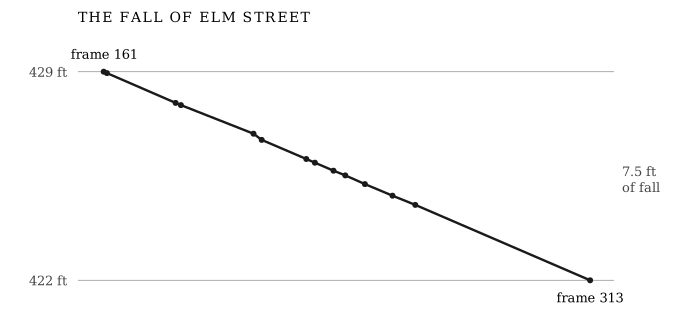
There is one frame before it. At 312 the President is leaning toward his wife, wounded but alive, and the car is still just a car going down a hill. The next frame is the one nobody forgets. Between those two images is one eighteenth of a second, and everything after it in American life is on the other side.86#
Something does not happen, and it is the thing to notice. For more than a second after the fatal shot, the limousine keeps rolling at the same pace. No swerve, no acceleration. The driver has to be told. It is one of the details that surprises people most about the film: the most protected car in the world simply carried on down the hill while everyone in the plaza was already on the grass.87, 88#
You can see the exact frame a man catches a moving car. Around three seventy Clint Hill’s hand closes on the handhold at the back of the limousine, having run twenty-five feet from a running board while the car accelerated away from him. It is the single most physically impressive thing anyone does on that film, and he spent fifty years describing it as a failure.89, 24#
The most examined film in history is twenty-six seconds long. It ends around frame four eighty-six with the limousine going into shadow under the triple underpass and Zapruder still holding the camera. After that there is nothing. Everything anybody knows about the next ten minutes comes from people, not film, which is exactly why it is so much less certain.90, 7#
Every serious argument about this is conducted in frame numbers. Z133. Z225. Z313. Those are not timestamps. They are positions on a strip of film, and they became the shared language of the case because they are the one thing everybody accepts. Two people who agree on nothing else can both say Z313 and mean exactly the same instant. That is rarer here than it sounds.91, 7#
Early copies of the film are missing frames, and that has fed suspicion for decades. The dull explanation is that a lab technician damaged some in handling and they were spliced, and the damage is documented. It is a real gap in the physical film. It is also the sort of thing that happens when the only copy of something is passed around a photo lab in 1963.92, 93#
†There is a frame where the Governor’s jacket lapel moves. At 224, the lapel on his right side flips outward for a fraction of a second. For decades that flick of cloth has been argued as the visible moment a bullet exits his chest, which would fix the timing of the single-bullet conclusion almost exactly. Others say it is wind, or his own arm. A quarter of a second of a jacket, load-bearing.94, 7, 95, 96#
You cannot check a film against itself. What you need is a second camera. An Associated Press photographer standing on Elm pressed his shutter during the shooting, and his picture can be matched to a specific Zapruder frame. Placing the same people, the same car, the same instant, from a completely different angle. That single match is the anchor that lets the whole timeline be tested rather than assumed.97, 98#
Two people recorded the same fraction of a second from opposite sides of the street. Mary Moorman’s Polaroid was exposed within about a twentieth of a second of frame 315. A moment after the fatal shot. So we have a moving film from the north side and a still photograph from the south, made almost simultaneously. Everything ever argued about the knoll rests on the overlap between those two.25, 99, 95#
†Somewhere around frame 160, people in the film start to react. Heads turn. A girl stops running. A man on the curb looks up. None of it is proof of a gunshot. A backfire would do the same, but the cluster is real, and it sits far earlier than the official first shot. Where you place that first shot decides whether one rifle had enough time. This is the frame everything hinges on.100, 7, 101, 102#
For most of Elm Street she is facing away, waving at the crowd on her side. Then somewhere after frame two hundred and thirty she turns inward, toward her husband, and stays turned. That is a wife noticing something is wrong. One of the clearest human markers in the whole film, and it arrives before almost anybody else in the plaza has understood that anything has happened at all.103, 69#
†John Connally is holding a Stetson, and after he is hit he is still holding it. That detail has been used for sixty years to argue about when he was wounded, because a man with a shattered wrist should not be able to grip a hat. Doctors point out that a hand can close reflexively and stay closed. It is a genuinely hard piece of evidence, and it is a hat.104, 105, 106#
When the film was first published as still photographs in 1963, the magazine printed the sequence and left out the worst of it. For twelve years the public knew the numbers of frames they had never seen. A generation grew up able to name an image they could not look at, which is a strange kind of famous, and it is a large part of why the film acquired the weight it has.107, 108#
Nobody in Dallas numbered anything. The frame numbers everyone now quotes were assigned afterwards, by investigators working through the developed film to build a timeline. That is why the count starts at a seemingly arbitrary point. It starts where the camera restarted. Every reference in every book, every argument that turns on a number, uses a scale somebody invented in an office months later.7, 109#
†After the fatal shot there are a few frames that have generated an entire literature. Shapes at the edge of resolution, read by some as physical detail and by others as film grain and motion blur. Both camps are looking at the same handful of frames on eight millimeter film, magnified far past what the emulsion can carry. At that magnification the film stops being evidence and starts being an inkblot.110, 95, 111#
Add it all up. The film everyone argues about runs about twenty-six seconds, of which the shooting occupies roughly six. Fewer than 500 frames. Every book, every hearing, every documentary, every theory on the internet, is an argument about a few hundred squares of eight millimeter film shot by a man who had gone out at lunchtime to watch a parade.112, 7#
Timing
Read every book on this and you are reading about roughly six seconds. From the first shot to the last is somewhere between five and a half and eight and a half seconds, depending on which shot you count as first. Six seconds. That is shorter than this sentence takes to say twice. Sixty years of argument, thousands of books, and the whole of it fits inside a held breath.113, 101, 114#
There was no timestamp on anything that day. No CCTV, no phones, no synchronized recording. The only reason anyone can say what happened at what second is that a man’s camera ran at 18.3 frames a second and never stopped. Every timing in every report is measured in Zapruder frames. A dress manufacturer’s home movie camera is the master clock for the whole event.7, 115#
†A great deal turns on one mechanical question: how quickly a bolt-action Carcano can be worked and re-aimed. FBI marksmen tested it and produced figures around two and a third seconds between shots. Others testing the same weapon have produced slower times, and some faster. That single number decides whether the shot sequence fits one rifle. It has never settled, because it depends on who is holding it.116, 117#
One number in this case does not need explaining to anybody who studies it. Frame 313. It is one eighteenth of a second of film, and it is the moment the fatal shot strikes. Life magazine printed the film in 1963 but held that frame back. For twelve years the public knew the number without ever having seen it. A single frame became the most withheld image in America.28, 118#
The Zapruder film was not shown to the American public as a moving picture until March 1975, on late-night television. Twelve years. The reaction to that broadcast is a large part of why Congress reopened the investigation two years later. A piece of evidence that had existed since day one changed the course of the inquiry only when ordinary people were finally allowed to watch it.119, 120#
†Almost everything about the last shot is settled. The first one is not. Estimates for when it was fired range across dozens of Zapruder frames, and the whole timing question depends on it, because if the first shot came earlier, there is more time for one rifle, and if later, there is less. The argument that has run for sixty years is not really about the killing. It is about when the clock starts.7, 101, 121#
†The acoustic analysis was, above everything else, an argument about spacing. It read four impulses on a police recording and placed two of them close enough together that a single bolt-action rifle could not have produced both. That is why it mattered. Not because it located a gunman, but because it produced an interval, and every argument that followed for twenty years was about whether that interval was real.122, 123#
In 1964 surveyors went into Dealey Plaza with instruments and measured where the President’s car had been at fourteen specific frames of the Zapruder film. That document, Commission Exhibit eight eighty-four, is why this recreation can put the limousine within about eight inches of where it actually was. Everything in this reconstruction rests on men with a theodolite standing in a road, months afterwards.124, 125#
Millions of pages relating to this case have been released, and releases have continued for decades. Almost nothing in them has changed the basic account of what happened in this plaza. What they have changed is the picture of what agencies knew about the suspect beforehand, and what they chose not to tell the Warren Commission. The secrecy in this case is mostly not about the six seconds.126, 127#
People assume this stays open because of some single hidden fact. It stays open for a duller reason. The event took six seconds, in a place with bad acoustics, in front of hundreds of frightened people, and was investigated in a hurry by organizations that were also protecting themselves. That produces a record with real gaps in it. Gaps are not proof of anything. They are just gaps, and they do not close on their own.128, 129, 130#
† disputed ‡ theory § reconstructed. Everything unmarked is established. Superscript numbers key to the sources below. Corrections
Sources for this chapter
130 sources. Every claim above is keyed to one of them. The complete list for the whole book runs to 1,276.
- Dealey Plaza geometry
- Dallas weather records, 22 Nov 1963
- the plaza photographic record
- WC testimony of Moorman, Hill, Brehm, Zapruder, Sitzman and Hudson
- the reconstruction's surveyed witness positions
- Williams WC testimony (3H161)
- Warren Report ch.3
- Warren Report ch.2 (motorcade progress and stops)
- contemporary press accounts
- Warren Report ch.2 (motorcade order)
- Love Field arrival accounts
- Nellie Connally WC testimony (4H146)
- CE 884 stationing
- Warren Report ch.2
- Zapruder film Z133-160
- Willis WC testimony (7H492)
- Norman WC testimony (3H186)
- Dealey Plaza acoustics
- Zapruder film Z160-200
- Zapruder film Z207-230
- Connally WC testimony (4H132)
- Greer WC testimony (2H112)
- Zapruder film Z280-312
- Hill WC testimony (2H132)
- Moorman Polaroid
- Hargis WC testimony (6H293)
- Newman WC testimony (19H488)
- Zapruder film Z313
- Zapruder film Z313-400
- Zapruder, Nix and Bond films of the aftermath
- DPD and Dallas County statements
- Baker WC testimony (3H242)
- Truly WC testimony (3H212)
- Warren Report ch.4
- Holland WC testimony (6H239)
- Smith WC testimony (7H531)
- Bowers WC testimony (6H284)
- Parkland admission records
- bystander testimony
- DPD radio logs
- Brennan WC testimony (3H140)
- Warren Commission witness statements
- eyewitness memory research
- WFAA-TV interview, 22 Nov 1963
- Zapruder film Z313+
- Zapruder WC testimony (7H569)
- the film itself
- the reconstruction's surveyed position for the pedestal
- Sitzman interviews
- Brehm FBI statement, 22 Nov 1963
- Hill WC testimony (6H205)
- later Hill interviews (contradictory)
- Zapruder film
- Hudson WC testimony (7H558)
- Zapruder film (figures on the steps)
- Moorman WC testimony (19H487)
- the Moorman Polaroid
- the reconstruction's surveyed position for this witness
- Gary Mack & Jack White, 1982 (the Badge Man claim)
- subsequent photographic analysis of the Moorman print
- the reconstruction's stockade fence geometry
- John Connally WC testimony (4H129)
- John Connally WC testimony (4H132)
- Zapruder film Z224–290
- Zapruder film Z280–313
- Warren Report ch.2 (speed)
- Zapruder film Z313–390
- Hill's later published accounts
- Jacqueline Kennedy WC testimony (5H178)
- Zapruder film Z313–375
- Kellerman WC testimony (2H73)
- Secret Service radio log
- other overpass witnesses (Simmons, Dodd, Miller)
- Secret Service statements on agent deployment
- Altgens photograph
- Tague WC testimony (7H552)
- Warren Report ch.3 (the Main Street curb, CE 3082)
- Zapruder film Z207–222
- the reconstruction's sign geometry
- Zapruder film Z133
- Warren Report ch.3 (foliage)
- CE 884 surveyed frames including 186
- Zapruder film Z224-230
- HSCA forensic pathology panel
- Zapruder film Z280-290
- Zapruder film Z312-313
- Zapruder film Z313-350
- Warren Report ch.2 (limousine speed)
- Zapruder film Z360-390
- Zapruder film, end of exposed footage
- FBI testing of the Zapruder camera speed
- Life magazine and Jamieson lab handling records
- HSCA photographic panel on film integrity
- Zapruder film Z224
- HSCA photographic panel
- the single-bullet literature
- Altgens AP photograph, 22 Nov 1963
- HSCA photographic panel frame-matching
- Zapruder film Z315-316
- Zapruder film Z155-170
- HSCA timing analysis
- Willis and Rosemary Willis reactions
- Zapruder film Z225-260
- Zapruder film Z275-300
- Connally WC testimony (4H129)
- HSCA forensic panel on the wrist wound
- Life magazine publication of Zapruder stills, 1963
- publication history to 1975
- FBI and Secret Service frame-numbering of the Zapruder film, 1964
- Zapruder film Z313-340
- the enhancement literature and its critiques
- Zapruder film, full exposed sequence
- Warren Report ch.3 (shot timing)
- Zapruder film frame rate 18.3 fps
- FBI determination of the Zapruder camera speed at 18.3 fps
- Warren Report ch.3 (FBI marksman trials)
- HSCA firearms panel re-testing
- Life magazine publication history, 1963-1975
- Goodnight America broadcast, March 1975
- HSCA establishment, 1976
- the range of proposed first-shot frames in the literature
- HSCA final report, 1979 (acoustic evidence)
- National Academy of Sciences review, 1982
- CE 884 (WC Hearings XVII p.902)
- the reconstruction's fit to Commission Exhibit 884
- JFK Records Act releases, 1992 onward
- HSCA findings on agency disclosure to the Warren Commission
- Warren Report
- HSCA final report 1979
- JFK Records Act releases