3 sections in this chapter
The ground, measured
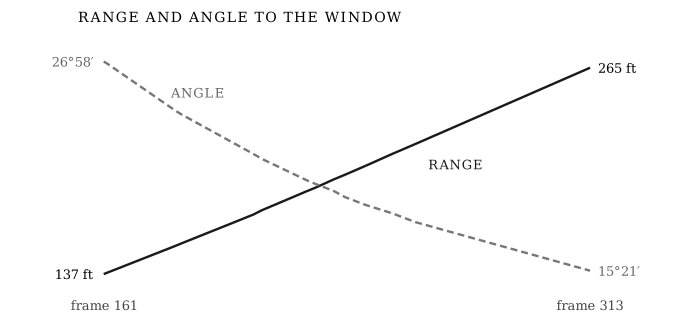
At the final shot the car is about 265 feet from the sixth-floor window. Two hundred and sixty-five feet is close to the length of a football field, seen from six stories up, with a telescopic sight. People imagine a distant, expert shot across a wide plaza. It is closer to shooting at something on the far side of a school playing field, from a window, with the target coming almost straight away from you.1, 2#
People say a shot from the front, and picture someone directly ahead of the car. The fence corner is not in front. From where the President was sitting at frame three thirteen it is forward and to his right, roughly at his ten o’clock if he had turned. Getting the geometry right matters, because half the arguments about entry and exit assume a shooter standing somewhere nobody has ever placed one.3, 4#
Elm Street falls away the entire time. The car is accelerating gently under gravity, the shooter is shooting downward, and the angle changes with every frame. That is why the trajectory arguments are so hard to follow and so easy to misuse: nothing in this event happens on a level surface, and a diagram drawn flat will give you the wrong answer every time.5, 6#
Stand where Mary Moorman stood and turn round. The sixth-floor corner window is right there, up and behind you, in plain sight across the street. Nothing hides it. Everyone on that grass could have seen it at any moment simply by looking up. Nothing was hiding it, which is what makes the whole thing feel impossible, and also why almost nobody bothered.7, 8#
From most of the south side of Elm, the view of the fence corner is broken up by the pergola. Its columns, its shadow and the trees around it. That is not a detail. It is a large part of why witnesses on that side gave such different accounts of what was on the knoll: several of them were looking at it through a colonnade.9, 10#
James Tague was not standing near the car. He was on Main Street, well down toward the underpass, roughly 500 feet from the sixth-floor window. For a fragment to reach him, a shot had to miss everything and travel a long way past the target. That distance is the reason the missed shot is so hard to place in the sequence, and why it is still argued about.11, 12, 13#
The two most important pieces of imagery from that day were made by people standing on opposite sides of the street, about 115 feet apart, at the same instant. One is on a concrete block looking across the car. One is at road level looking past it at the fence. Two ordinary people with cheap cameras, 115 feet apart, produced most of the visual record of the century.14, 15#
The railroad bridge at the end of Elm is not high. The men standing on its parapet were only a few feet above the road, looking almost straight down the street at the oncoming car. It gave them an unobstructed view and a terrible angle for judging where a sound came from. High enough to see everything and low enough to hear the whole plaza echo at once.16, 17#
Down the whole length of Elm the President is within about a hundred feet of somebody on foot, and usually much less. Spectators on both curbs, agents twenty-five feet back, motorcycles at two. This was not a sealed convoy moving through empty streets. It was an open car in a crowd, and every account we have exists because the crowd was that close.18, 19#
Count six seconds to yourself. That is the whole event. Everything in this plaza. The shots, the reactions, the running, the woman on the trunk, a man catching a car on foot. Happens inside a span you have just sat through doing nothing. Sixty years of books and film and argument, and the thing itself is over before you finish reading this sentence out loud.20, 21#
The sixth-floor window sits about sixty feet above the street. That is roughly the height of a five-story block, or a tall tree. Not a tower, not a skyscraper. If you stand on Elm Street and look up at it, the thing that surprises people is how close it feels. Close enough to shout at somebody and be heard.22, 23#
Elm Street drops about twenty-four feet between Houston Street and the triple underpass. Across 500 feet that is a gentle slope you would barely notice walking. It is also enough to change the angle from an upstairs window with every second, and it is why every trajectory diagram drawn flat gives the wrong answer.5, 6#
Zapruder’s camera ran at 18.3 frames a second, which is not a round number and never was. Every conversion in every report. Frames to seconds, seconds to distance, distance to angle. Passes through that figure. One decimal place, established by testing a home movie camera, holds up the timing of the entire case.24, 11#
In 1964 surveyors fixed the President’s car at fourteen specific frames of the Zapruder film and wrote down the station and the distance to the sixth-floor window for each one. Fourteen points. That is the entire measured basis for where that car was at any moment, and every reconstruction since, including this one, is interpolating between them.25, 2#
Down Elm Street the car averaged roughly eleven miles an hour. Put that in units you can feel: it is a slow jog, or a bicycle freewheeling, or about sixteen feet a second. In the time it takes to read this sentence aloud, that limousine moved about the distance from home plate to the pitcher’s mound. Everything in this case happens at the pace of a man running.26, 27#
From the corner of the stockade fence to the point where the President was hit is roughly a hundred feet. That is the length of a swimming pool, or a third of a city block. It is close enough that a rifle needs no skill at all, and close enough that the people standing on that grass would have been almost underneath it. Both facts are true and they pull against each other.3, 28#
From the corner of Houston to the mouth of the triple underpass is about 500 feet. That is the stretch of road this entire subject is about. Every book, every documentary, every argument for sixty years concerns a piece of street you could walk end to end while a kettle boils.29, 30#
The gap that decides a great deal is about ninety seconds. The time between the last shot and a policeman confronting a man in a second-floor lunchroom. Whether that is enough time to come down from the sixth floor by stairs has been tested, re-tested and argued over for six decades. A minute and a half of an ordinary Friday, measured to the second, forever.31, 32#
The supporting record runs to twenty-six volumes, containing testimony from over 500 witnesses and more than three thousand exhibits. It has been public since 1964. Nearly every claim anyone makes about this case, on any side, is a quotation from that shelf, usually second-hand, usually from someone who has not opened it.33#
Here is the whole thing in two numbers. The event lasted about six seconds. The argument has lasted sixty years. That ratio, ten years of dispute for every second of event, is the real subject of this book. Not what happened, which is mostly settled, but why so little time can absorb so much attention and still not be finished.20, 34#
What each vantage could see
From the moment the car straightens onto Elm, the sixth-floor window is behind the President and getting further away. Every second that passes makes the shot harder, not easier. That is the geometry that makes the turn so strange. The range at the corner is under a hundred feet, and by frame three thirteen it is about two hundred and sixty-five. Whoever was in that window let the easy shot go and took the long one.35, 2#
The corner window on the sixth floor is a sash window, and it was open at the bottom only. Raised about a foot and a half. Nobody stood at it. To shoot through that gap you have to be down, kneeling or sitting, resting on the sill or on a box. That is why there are cartons arranged the way they are, and it is why almost nobody in the plaza saw a figure.36, 37#
Stand at the corner of the stockade fence and look down at the road. There is nothing in the way. A low rail, mown grass, then the roadway. Anyone standing there has a clean and slightly downward view of a car moving away from them and to the left, at about walking pace. That is the sightline, and it is unobstructed. What no measurement will ever tell you is whether a person was standing in it.3, 38#
A dozen or so railroad men and a policeman stood on the triple underpass and watched the car come straight at them for the whole length of Elm. No sign in the way. No tree. Nothing. They had the cleanest continuous view of the shooting of anyone in Dealey Plaza. And their accounts of how many shots there were, and where from, disagree as much as anybody else’s.39, 40#
The three men closest to the rifle could not see it. Norman, Williams and Jarman were leaning out of fifth-floor windows directly below the corner window, one story down. From there the shooter is above and behind a concrete sill. They heard everything and saw nothing. In this whole plaza, proximity and visibility are almost never the same thing, and that is the single most useful idea for reading any witness here.41, 42#
Mary Moorman was photographing the President, but look at what is behind him. From her position on the south grass, the background of that Polaroid is the stockade fence and the pergola. That is why one snapshot of a passing car became sixty years of forensic argument, not because of what she aimed at, but because of what happened to be standing behind it.43, 44#
†Everyone looks at the Depository. Directly across Houston Street is another building with the same line of fire and taller windows. The Dal-Tex building overlooks Elm from almost the same angle. Nobody was arrested in it, no weapon was found in it, and no evidence has ever placed a shooter there. It is named in theories mostly because it is there and it fits. That is not evidence. It is just architecture.13, 45#
Two places have been proposed as firing positions, and it is worth asking whether they can see each other. Stand at the stockade fence corner and look back at the Depository. The sixth-floor window is there, across the plaza, about 330 feet away and clearly in view. Anybody at that fence had the other alleged position in plain sight the whole time.3, 46#
Out of the hundreds of people in Dealey Plaza, only a handful were looking up at all. Brennan on his wall. Euins on the corner. A couple of others. Everyone else was doing what you would do. Watching a President and his wife go past in an open car. The building was full of windows, in plain view of a crowd, and it was effectively unobserved. That is not a conspiracy. That is just what crowds look at.47, 48#
Photographs make this plaza look big. It is not. From the Depository door to the triple underpass is about 500 feet. You can walk it in two minutes. Every person in every one of these stories was inside a space the size of two football pitches. All of it, everyone, in a park you could cross while a kettle boils.29, 30#
A tree stood between Kennedy and the rifle for two and a half seconds. A live oak on Elm, dead in the sniper’s line of fire, hiding him in the leaves from frame 166 to 210, with one opening at frame 186. Surveyors measured fourteen positions here in 1964, and six of them sit at this tree. They weren’t measuring a road.49, 50, 51#
Go and sit on the low wall on Houston Street where Howard Brennan ate his lunch, and look up. The corner window is about sixty-five feet away and maybe 60 feet up. You can see into it. A person at that window is a person, not a shape. Everything his testimony was ever worth comes down to a distance you can pace out in half a minute.52, 3#
There is one stretch of Elm Street where the most important film ever shot can see nothing at all, and the recreation can. Put the camera at Zapruder’s eye and the road sign swallows the car for fifteen frames. Then move fifty feet and the same instant is wide open. That is the argument for building this: not to prove anything, but to look around an obstruction that a witness could not.53, 54#
Walk a block south of Elm, to Main Street near the underpass. James Tague stood there to watch the car go by, about 400 feet from it. Far enough that he assumed he was nowhere near any of it. A fragment came off the curb and cut his cheek. He is the only person other than the two men in that car who was injured, and he found out he was evidence when a deputy noticed the blood on his face.11, 55, 56#
§Sit in the driver’s seat and look where Bill Greer would have looked. The interior mirror of that car gives him a narrow view of the back seat over his right shoulder. Enough to register movement, not enough to understand it. This is a reconstruction, not a measurement, and it is labeled as one. But it shows why a trained man turned his whole head instead. He could not see what was happening any other way.57, 58, 59#
Stand in the middle of the lawn and turn all the way round. The window is there. The fence is there. The underpass is there. The pergola where a man filmed it is there. Every location that sixty years of argument has been about is visible from one spot, without moving your feet. That is the fact this whole project was built to make plain, and it is the one nobody writes down.60, 30#
What the ground refuses
Everything anybody asks about that afternoon falls into one of two piles, and almost all the confusion in sixty years comes from people not noticing which pile they are in. There are questions about where things were, and there are questions about what people intended. The first kind has answers. The second kind has arguments. This chapter is about the first kind, and about being honest when you cross the line between them.61#
Here is what is simply finished, and no future document will reopen any of it. How far the window was from the car at any moment. How steep the angle was. How fast the car was going. How much of the road the tree covered. What a person standing at the fence could and could not see over it. Whether the plaza is flat. Whether anybody on that grass could have seen the sixth floor. Those are measurements, they have been taken, and they do not have another side.62, 28#
And here is what no amount of measuring will ever touch. Who was in that room. How many shots there were. Which direction each one came from. Whether a man could make a shot, as opposed to whether the shot was geometrically possible. What anybody meant to do. Every one of those is a question about people, and a model of a place contains no people. I can tell you a rifle could reach the car. I cannot tell you a finger was on it.63#
Watch any argument about this for ten minutes and you will see it happen. Somebody makes a claim in the second pile and defends it with evidence from the first. The distances prove a shooter could not have done it. The angles prove there was a second man. They do not. Distances prove distances. The moment a measurement is asked to carry an intention it stops being evidence and becomes decoration, and both sides do it constantly.61#
If you take one number away from this entire book, take this one. Eighteen point three frames a second. That is the speed the camera was running, and it is the only clock anybody has for those six seconds. Every argument about how many shots were possible, about whether a bolt could be worked in time, about the spacing between impacts, is settled by dividing frames by that figure. Not by opinion. By division.64#
†Now the uncomfortable part, which is that the whole timing of this case hangs on one measurement of one second-hand home movie camera, taken by an agency with a view about the answer. It has been re-checked and it holds. But an enormous amount of confident argument, on both sides, is ultimately resting on how fast a spring in a Bell and Howell was unwinding on a warm afternoon in 1963. That should make everybody slightly more careful than it does.65#
So I am not claiming that measuring the ground solves this. It does not and it never could. What it does is smaller and more useful. It clears the floor. It takes a set of claims that have been argued for sixty years and moves them out of the argument permanently, so that whatever is left to fight about is at least worth fighting about. That is the entire promise of the subtitle on the front of this book, and it is deliberately modest.61#
† disputed ‡ theory § reconstructed. Everything unmarked is established. Superscript numbers key to the sources below. Corrections
Sources for this chapter
65 sources. Every claim above is keyed to one of them. The complete list for the whole book runs to 1,276.
- CE 884 line-of-sight distances
- the reconstruction's motorcade track, fitted to Commission Exhibit 884
- plaza survey geometry
- the reconstruction's sightline tests from the fence corner and the frame 313 position
- CE 884 elevations
- the reconstruction's elevation model
- plaza sightline geometry
- the reconstruction's sightline tests from the Moorman position and the sixth-floor window
- the reconstruction's pergola geometry
- Dealey Plaza site plans
- Warren Report ch.3
- CE 3082 curb location
- plaza geometry
- the reconstruction's surveyed scene positions
- Zapruder film and Moorman Polaroid
- triple underpass geometry
- the reconstruction's geometry for the underpass deck
- the reconstruction's surveyed witness positions
- plaza photographic record
- Warren Report ch.3 (shot sequence duration)
- Zapruder film timing
- Texas School Book Depository elevations
- CE 884 line-of-sight data
- FBI testing of the Zapruder camera speed
- CE 884 (WC Hearings XVII p.902)
- Warren Report ch.2 (limousine speed)
- CE 884 frame stationing
- the reconstruction's sightline tests
- Dealey Plaza survey dimensions
- the reconstruction's plaza survey data
- Baker WC testimony (3H242)
- Warren Report ch.4 (timing reconstruction)
- Warren Commission Hearings and Exhibits, volumes I-XXVI (1964)
- the subsequent literature
- CE 884 (WC Hearings XVII p.902) line-of-sight distances
- DPD crime scene photographs of the sixth-floor window
- Warren Report ch.3 (the sniper's nest)
- the reconstruction's elevation model and fence position
- Holland, Simmons, Dodd, Miller WC testimony
- DPD deployment on the underpass
- Norman WC testimony (3H186)
- Depository facade geometry
- Moorman Polaroid
- the reconstruction's sightline test from the Moorman position
- absence of physical evidence relating to Dal-Tex in WC and HSCA records
- the reconstruction's sightline tests from the knoll and the sixth-floor window
- Warren Report ch.3 (witnesses who observed the window)
- Dealey Plaza photographic record
- WR ch.3, foliage obscured the view from frame 166 to 210, opening at 186
- CE 884 (WC Hearings XVII p.902), surveyed frames 161, 166, 185, 186, 207, 210
- the reconstruction's motorcade track and modeled live oak
- Brennan WC testimony (3H140)
- Zapruder film Z207-222
- the reconstruction's geometry for the Stemmons Freeway sign
- CE 3082
- Tague WC testimony (7H552)
- SS-100-X interior configuration
- Greer WC testimony (2H112)
- reconstruction, not survey-derived
- Dealey Plaza survey geometry
- the author's assessment
- Commission Exhibit 884
- the reconstruction's documented scope
- FBI testing of the Zapruder camera, Warren Report chapter III
- Warren Report, chapter III, camera testing